
The Red Wing Innovation Incubator

As mentioned below, much of the year has been taken
up with the generation of the Red Wing Creative
Economy report.
Related, and even more of a time sink, has been the
initiation of the Red Wing Innovation Incubator.
This is a physical space dedicated to help grow and
mentor new businesses in the Red Wing Community.
This activity is being driven by Red Wing Downtown
Main Street and our involvement is because of a firm
belief that the stronger the local economy is, the
stronger our business can become.
Visit the web site and see what the hub-bub is all
about. Red Wing
Innovation Incubator.
Busy, busy , busy...
It
has been busier here than it might appear.
Earlier this year, we became involved in a project to
try and measure the local Creative Economy and
contrast it to other communities. Armed with this
information, the goal becomes to make defensible
recommendations going forward.
This is important to our business for obvious
reasons, but it is also important to the community
because this is where the economy is growing very
rapidly.
We couldn't (or even shouldn't) do a significant
project like this alone. We partnered with the
Southern Minnesota Initiative Foundation, Red Wing
Downtown Main Street, Inc., Anderson Center at Tower
View, Red Wing Arts Association, ArtReach and the
Sheldon Theatre of Performing Arts.
This is good company to keep and adds credibility to
the final report.
We are proud of the final report and encourage you to
download your own
copy.
Catch-up/ketchup
We have been very busy re-inventing here at the shop.
To begin with, we have been very focused on slowly
unveiling Red Wing
Digital. Red Wing Digital is a print-on-demand
product that provides unique large-format
presentation products, namely the
Panel Print and the
Acrylic Print. The Acrylic Print is slowly
getting ready for production, but it has taken longer
than hoped.
Secondly, we have a new business partner. Fine Art
Prints on Demand is a United Kingdom company.
This is a side of the business (printing and framing
fulfillment) we have been quietly working and growing
for a number of years. FAPoD is our third customer
for this side of the business.
These two developments have driven our third
initiative. We are moving our production to a larger
facility. We have narrowed our options down and
expect to be able to make some final decisions
shortly.
The tale of the table under the tent...
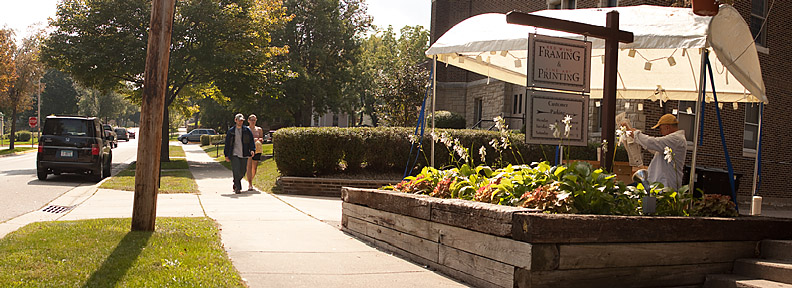
Think
of the picnic table under the canopy tent in the
parking lot as Social Networking 1.0. It is the most
fundamental device for creating community networks.
World problems have been solved and judgment passed
on every local politician at this very table.
Just last month under this tent Leah Nesbitt was
declared the 2009 Downtown Red Wing Macaroni and
Cheese Smackdown Champion (she used all Wisconsin
natural ingredients).
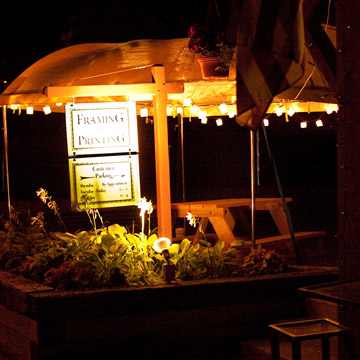
At night the little Japanese lanterns are lit up and
the table becomes more of a 'night spot' where topics
are dissected, examined and reassembled, many times
over fermented nectar and usually in hushed voices.
In the mornings, it is a destination for coffee and a
newspaper.
Warren
Buffet would appreciate how effective this $70 picnic
table is as a marketing tool.
Eat. Shop. Play. Local.

Recently
a letter to the editor of the local newspaper made
the argument for funding art at the elementary school
level. Apparently there has been discussion about
reducing the amount of art received in elementary
schools because of budget pressures. The typical
solution has been to increase the tax levy and ask
the tax payers to pay more.
A more sustainable approach is to simply spend local.
Every dollar spent locally in a community can have up
to three times the multiplier tax return to the
community versus buying from an out-of-state big box
retailer, all without raising taxes a single cent.
Let's use two simple examples:
Example 1) A citizen spends a dollar at a local
big-box retailer. Taxes are exchanged for that dollar
spent and the dollar is promptly deposited in an
out-of-state bank account somewhere in Four Corners,
Arkansas. That dollar is retired as far as the local
economy is concerned.
Example 2) A citizen spends a dollar at their local
custom frame shop. Again, taxes are exchanged but
this time the local frame shop owner races to their
local bank to cover the check they wrote to the local
plumber to have their hot water heater repaired. The
plumber in turn cashes that check to buy a silk suit
from Josephsons Clothing Store. Tom from Josephsons
then uses that money to buy himself a beer next door
at The Staghead Restaurant to celebrate having
finally sold that XXXL silk suit.
The same dollar has contributed to the local economy
three separate times, each time participating in the
overall tax exchange and actively contributes to the
cash flow of four different local employers.
Red Wing Downtown Main Street is focused on exactly
these types of issues. The Eat-Shop-Play-Local
tag-line could include many other action verbs (Buy.
Stay. Invest.), but the point is to think about where
your money goes after you spend it.
Visit the DTMS web site or
the
DTMS Facebook page and consider joining this
non-profit organization.
CSI: Red Wing
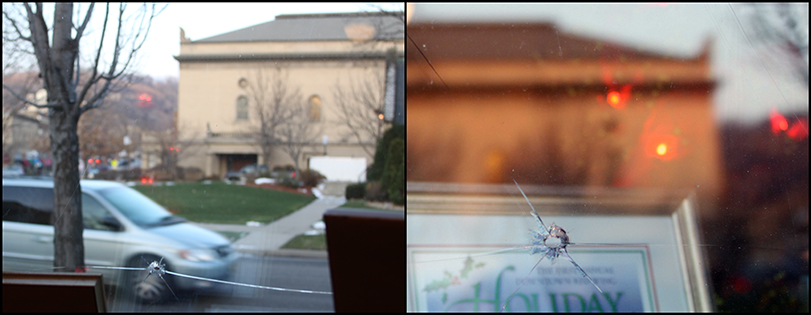
I grew up on Dragnet. I know how crimes of this nature
are solved.
First you interview all the neighbors, learn what
they may have seen or heard. Talk fast, so they
answer fast. When they begin to wander off topic (as
citizens will do), bring them right back on topic.
Rattle their cage a bit and leave a business card in
case they think of anything later.
Then look for motive. Investigate the victim and see
if there are any gambling or large debts owed. Find
out if there is a 'dame' involved. Follow-up on any
motel matchbook covers or cocktail napkins you might
find.
This case quickly boiled down to one of two theories:
an expert sharpshooter with a middle-European accent
was poised on the roof of The Sheldon Theatre and, in
a case of mistaken identity, attempted an
assassination under the cloak of darkness.
Or...
Two punks in a p-o-s car fired a wrist rocket at my
window and several of my neighbor's windows.
Thanks.
Future home of Red Wing College of Interesting Knowledge?
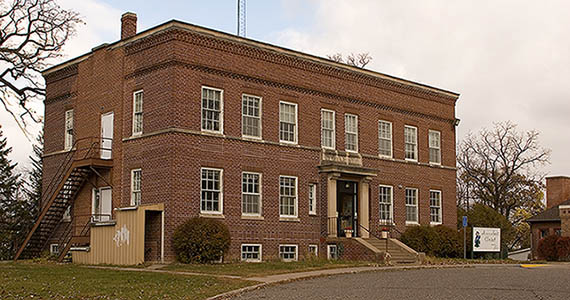
Or maybe; future of home of Red
Wing Research Park?
This is a city owned building, which was originally
the Red Wing City Hospital. It will soon be
vacant.
Save The Chief, re-revisited...
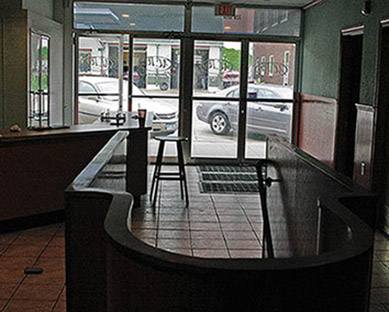
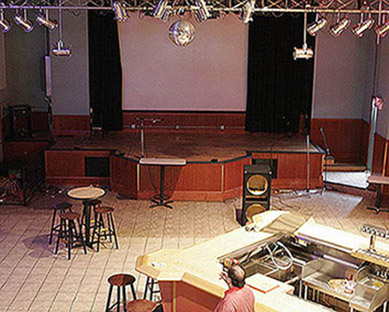
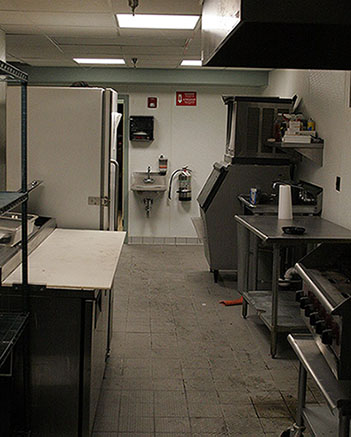
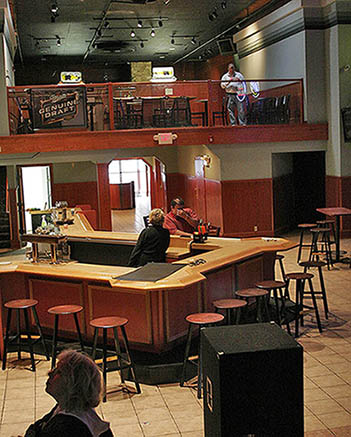
Here
are some snapshots from last week's walking tour of
The Chief Theater. The first shot is from the lobby
looking back towards the street (the updated
restrooms would be on the right side and the kitchen
is on the left side). The second shot is from the
balcony looking towards the original screen. The
third shot is the kitchen galley. The pizza ovens are
gone and the walk-in meat cooler is behind me. The
fourth shot is from the screen stage looking back
towards the theater. I have other photos, but this is
enough to get the idea of the condition of the
interior.
In summary, it looks almost exactly like it did a
year ago when I walked through it. The general
condition is very good, there are some very nice wood
appointments and the mechanicals are all new or
nearly new (plumbing, HVAC and roof). The kitchen is
nearly new and there are three walk-in refrigerated
rooms/coolers. The bar takes up a significant part of
the main floor and the basement needs a good bleach
scrub.
The
owner suggested a selling price of $1.3MM, but he
will entertain offers. The basic footprint is about
5,000 square feet, with multiple interior levels.
For the Red Wing community, the opportunity is that
this is one of the last authentic downtown single
screen movie theaters in the area. Once it is gone,
it is gone forever.
Save The Chief, revisited...
I will post some photos and feedback later this week (right now I am late for a family dinner), but in the mean time, I wanted to thank everybody who participated.
Save The Chief
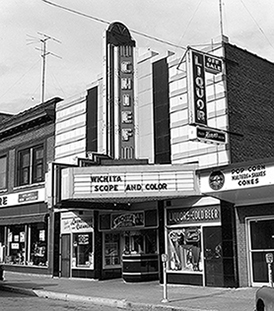
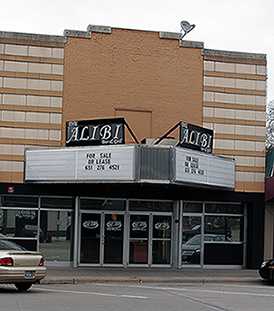
Here
are my arguments for why The Chief Theater should be
protected and re-opened as an authentic downtown
single-screen theater.
Just to recap why this is even an issue:
The Chief Theater opened in downtown Red Wing on
January 21st. 1939. It was one of three downtown
movie theaters and operated in a continuous fashion
until 1994. Since then, it has been a bingo hall, a
senior's center and several notorious bars. It is
currently empty and has been for sale for over a
year. The last business was a bar that was a trouble
spot and a source of crime. The police were called on
a regular basis. The bar closed when the liquor
license was revoked because the operators had not
bothered to get liability insurance.
The interior is actually in terrific shape. The main
floor has been leveled (unfortunately) with poured
concrete, but the restrooms have been updated, the
roof and mechanicals are brand new and there is a
full kitchen line complete with a walk-in cooler and
two pizza ovens. The original screen is still in
place. The projection room and the equipment are long
gone, but the core of the screening room still exists
(sans seats).
An argument could be made to save The Chief for
either nostalgic or historic purposes. I feel an
argument based on economic development is much
stronger. With proper management and focus, a
downtown theater can revitalize and re-energize a
community. The Normal Theater in
Normal, Il and the Riverview
Theater in
Minneapolis are success stories and the neighborhoods
have thrived because these theaters have encouraged
community investment. Restaurants, coffee shops,
retail, housing and hotel projects have been
attracted to these theaters because of the thriving
foot traffic it creates and the sense of community.
Many of these types of theaters fail, mostly because
of poor management. The successful theaters succeed
because the screens are worked very hard. The
Riverview can show up to four different movies on a
given weekend day; something in the mornings for
young families, early matinees for retired folk,
early evening for couples and a midnight cult
favorite. Not to mention film festivals, large group
meetings and even rented for church services if
necessary.
It attracts commerce, culture, young families and
retirees. It is exactly what a core downtown needs to
prosper and it is unique to Red Wing.
Downtown Red Wing has a terrific opportunity to save
something that other communities have had, lost and
now regret. Red Wing government agencies are always
talking about smart, long term investments. They only
need to look at 325 Bush Street.